
Code Inventory
We’ve collected and classified the diversity of laws currently defining and regulating LUVs and similar vehicles across the US. Each major group of regulations has its own page.
Beyond E-Bikes: Understanding Local and State Regulations
This collection provides an overview of state and some local codes currently in effect for vehicles smaller than the standard automobile. It does not include statutes covering e-bikes within the increasingly standard three-class framework (up to 750W power, and with speeds no more than 20 mph throttle-only or 28 mph pedal-assist).
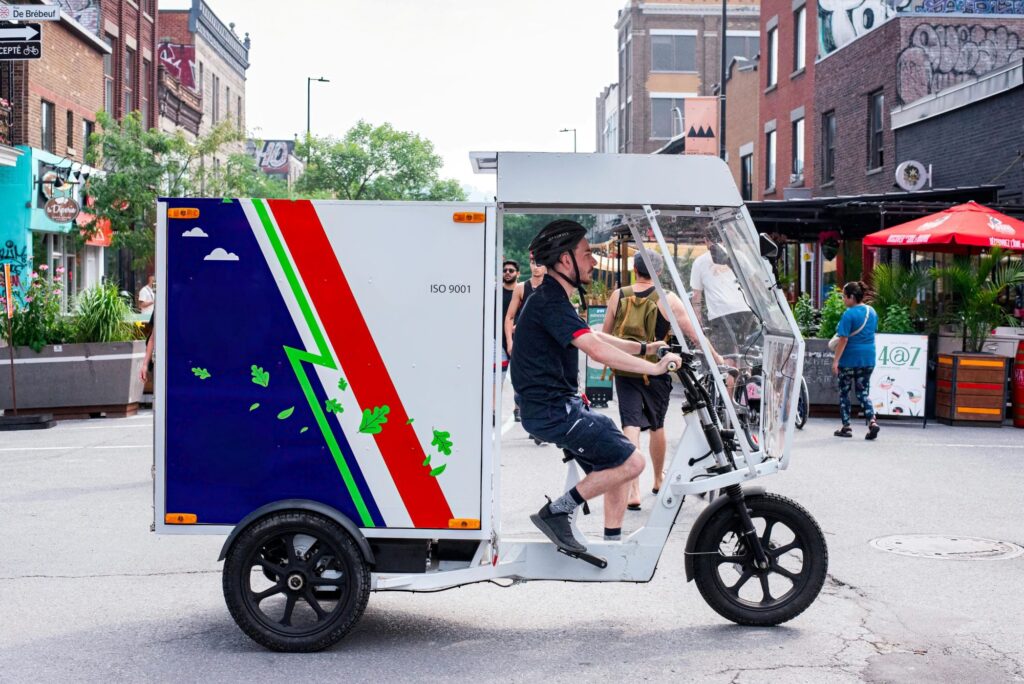
Some vehicle types of interest to the LUV Initiative, including e-cargo bikes, e-tuktuks, and microtrucks, tend to fall between the categories of e-bikes at the smaller end, and, depending on the form factor, motorcycles or LSVs at the larger end. Roughly speaking, the more “cycle-like” form factors (like those with handlebars and sometimes pedals, and where the driver sits astride the vehicle) tend to fall along a spectrum from e-bikes to mopeds to motorcycles, while the more “car-like” (like EU trikes and quads, kei vehicles, and UTVs/side-by-sides, with seats, steering wheels, and often full enclosure for the driver) are closer to the LSV-MSV-standard auto spectrum.
Many regulatory categories fall apart when vehicles have a non-standard number of wheels or a non-standard arrangement of them (more than two or three for the cycle-like, or fewer than four for the car-like), resulting in cases like e-cargo quads being classified as LSVs because they have four wheels, despite fitting in a bike lane and topping out around 15mph with pedal assist. Other categories fail because of speed or power limits. EU-style trikes and quadricycles (L5, L6, and L7 vehicles) are less than 4 ft. wide and weigh less than the smallest car on the US roads, but because they’re readily capable of arterial or even highway speeds, would be treated as standard autos under US rules. Since these categorizations flow from federal rules, states tend not to address them.
Car-Like Classes: LSVs, NEVs, MSVs, and Miniature Vehicles
Low-speed vehicles (LSVs) & NEVs
LSVs — commonly called Neighborhood Electric Vehicles — are 4-wheeled vehicles that meet specific federal standards (49 CFR 571) and are registered for use on low-speed roads in most states.
Differences across states relate primarily to speed limits, propulsion sources, and local authority. LSVs may have lower registration costs and are generally exempt from emissions testing.
Autocycle category
DC, Utah, and Kentucky have a specific Autocycle category for three-wheeled “tadpole” vehicles such as the Polaris Slingshot. In most cases, a motorcycle endorsement is not required.
Catch-all categories
Some states use additional designations — Personal Transportation Vehicle (GA), Unconventional Vehicle (ND), Cab Enclosed Motorcycle (OH) — as catch-alls for vehicles with fewer than four wheels that fall outside LSV definitions.
Medium-speed vehicles (MSVs)
Minnesota, Montana, and Washington have created an MSV designation with speed limits between 35–45 mph. NHTSA treats vehicles capable of speeds above 25 mph as standard passenger cars under federal law, creating a regulatory gap.
Miniature vehicles & kei vehicles
Texas, Indiana, North Carolina, and Colorado treat miniature/kei vehicles as a distinct category. Most must be modified or over 25 years old to meet federal safety exemptions.
Kei vehicles are often prohibited on roads above 55 mph. Registration varies widely, ranging from collector use to local-only authorization to outright bans, depending on the state.
See the LSV/MSV/NEV code inventory.
Cycle-Like Classes: Mopeds, E-motos, Scooters, and Motor-Driven Cycles
Classification between e-bikes and motorcycles
Most states have a special class for the smallest of these vehicles, placing them somewhere between e-bikes and motorcycles. Often, motorized bicycles are regulated the same as mopeds or mini-motorcycles.
Moped and motor-driven cycle definitions
Most state definitions are similar: a moped or motor-driven cycle is generally up to 50cc / ~3 hp/4 kW (most commonly only in cc’s), 2 or 3 wheels, automatic transmission, usually with operable pedals, and limited to speeds under 25 or 30 mph.
An intermediate class, larger than mopeds but smaller than motorcycles, may range from 50cc to about 250cc. Most e-motos would fall into the moped class in terms of speed and power.
Helmet laws and road restrictions
Most states have helmet laws at least for riders under 18, and most have restrictions on what roads these vehicles can be on — in general, no roads with speed limits over 35 mph.
Registration, insurance, and licensing
States have a wide variety of approaches to registration, insurance, and driver’s license or special endorsement requirements, with no clear trends or correlations — states with very similar moped definitions might have completely different registration requirements.
For example, Indiana requires title and registration of motor-driven cycles under 50cc at the same rate as motorcycles, plus a vehicle excise tax, does not require insurance, and limits riders to those 15 or over with a state ID and special endorsement or permit. Arkansas requires no registration for 50cc, but requires registration, title, and liability insurance for 50–250cc; riders must complete written and road tests for a specific endorsement.
State outliers
Wyoming does not have statewide regulations on mopeds. It instead treats any two-wheeled vehicle that travels faster than 30 mph as a motorcycle.
Pennsylvania is another unusual case: electric scooters do not comply with state standards and cannot be registered or titled in the state, making them illegal there.